Like the earth and the sky, the immense biodiversity of seeds and life forms is our collective heritage. Gifted by nature, and the cumulative innovations, adaptations and selections of many generations of farming communities, these seeds belong to all. They are our most vital wealth, essential for survival. They cannot be seen as mere commodities, to be bought and sold at will.
Allowing any variety of seed, germplasm, plant or animal (livestock) to become a patented / proprietary / corporate resource is a gross violation of natural justice, and a great suicidal blunder of modern economic civilisation.
Our amazing heritage of seed diversity and indigenous cattle breeds, adapted to diverse local conditions and needs, has the boundless potential to sustain farming and allied rural communities in independence, health and dignity for generations to come! Founded on unique, region specific landraces bred by farmers, these traditional seeds include varieties with unique features like tolerance to drought, cold, flood, salinity, and resistance to pests and diseases. The traditional crop seeds also include varieties that are highly nutritious / medicinal; and many that are high-yielding.
The great diversity of our traditional seeds is of vital importance to safeguard the lives and livelihoods of millions of farmers and the millions they feed, especially in a scenario of high soil degradation/ erosion, water scarcity, climate change, erratic weather, and looming shortages of non-renewable / chemical inputs of modern agriculture. Unless our farmers can adopt bio-diverse ecological agriculture with their own locally adapted seeds, severe food and nutritional scarcity looms ahead.
Sadly, we have already lost many traditional seed varieties since the wide promotion and adoption of the so-called ‘Green Revolution’ technology. Our heritage seeds, evolved over millennia, continue to get lost through neglect. If a seed variety remains unplanted for even a few years, its reproductive capacity is destroyed. It has thus become more urgent than ever to widely promote and share our remaining traditional varieties for decentralized in situ conservation and propagation on farmers’ fields, before they are irretrievably lost.
While traditional seed varieties can be saved and replanted by farmers from their own harvest, the commercial hybrid and GM seeds have to be repurchased every cropping season. Further, the traditional varieties grow quite well with only locally sourced organic inputs; but commercial hybrid and GM seeds are dependent for their yield on the addition of increasingly expensive toxic chemical inputs that are highly import dependent; and also greatly hazardous to human and ecosystem health. Such suicidal farming technology that relies on external industrial inputs devastates the atma-nirbharta (self-reliance) of both the farmer and the nation, making them highly vulnerable to sudden, sharply mounting scarcities, costs and foreign exchange outflows.
Today, the danger to our priceless collective heritage of agro-biodiversity from patented / proprietary commercial hybrid seeds and GM (genetically modified) crops is graver than ever. The GM crops (including the products of ‘gene editing technologies’) subvert the integrity of natural life forms, posing significant bio-safety concerns, with spill-over adverse consequences on human/animal health, soil biota and micro-organisms as well. With ‘Herbicide Tolerant’ GM crops like HT Mustard, the associated spraying of toxic herbicides will inexorably wipe out surrounding vegetation, sharply reducing both biodiversity and the availability of organic matter. The livelihoods of millions of farm workers too will be inevitably lost.
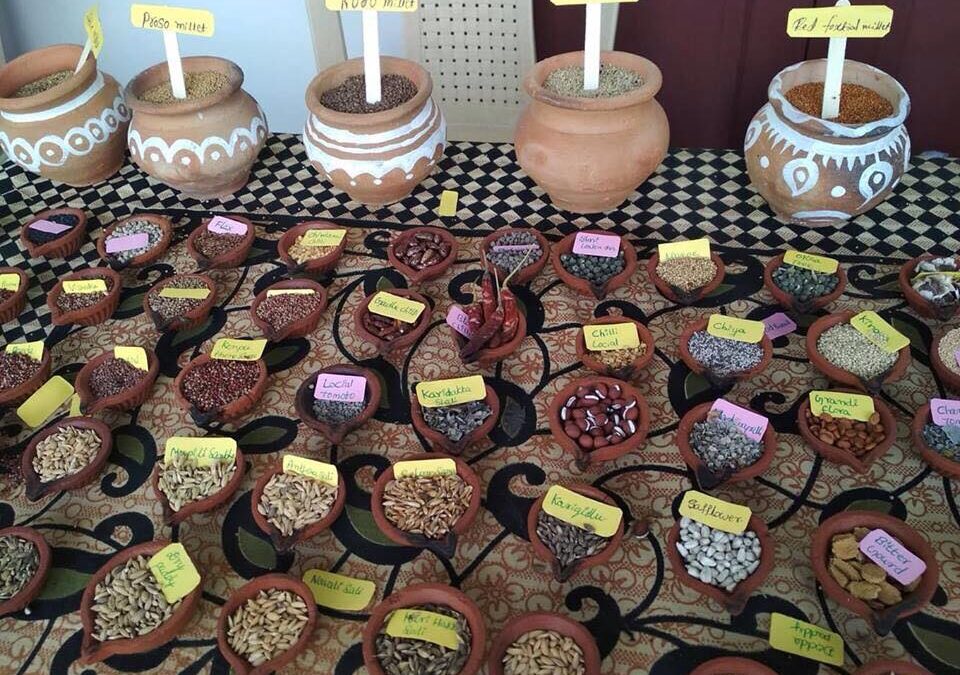
The GM crops also gravely threaten contamination and consequent ruination of our local crop varieties through cross-pollination; and through surreptitious admixtures of commercially purchased seeds. Further, the deceptive promotion and aggressive marketing of GM crops drives local varieties out of circulation. Consequently, any governmental sanction for open field trials or commercial release of any genetically tampered crops, germplasm, plants or organisms would be an anti-national, anti-farmer, anti-people and anti-Nature act with severe, irreversible consequences. Any steps in such direction need to be urgently and strongly resisted by all. This declaration was adopted at the National Beejotsav (Seed Festival), Mysore, November 11 to 13, 2022.
We thus hereby adopt the following seed sovereignty declaration:
1. We assert the farming communities’ and indigenous peoples’ sovereign rights over their collective bio-cultural heritage, including the right to freely plant, use, reproduce, select, improve, adapt, save, share, exchange or sell seeds, without restriction or hindrance, as they have done for past millennia.
2. We reject the validity of any private/corporate proprietary claim of ownership or patent over any variety of seed, germplasm, crop, plant or life form; and particularly any variety rooted in our natural heritage, cultural history and identity.
3. We demand a ban on GM seeds and species, and strict enforcement of corporate liability – immediate and long-term – for any contamination of seeds/plants, and any damage to the health of farmers, consumers, animals, croplands and eco-systems from the use, release, or open field trials of GM seeds and
4. We urge our government to partner with our farmers, gardeners, foresters and civil society organizations – in collaboration with academic institutions and Biodiversity Boards – to systematically and transparently record and document in a freely accessible database, our genetic wealth, particularly the diversity of our heritage crop/plant species and their numerous varieties, originating in or found in various regions and cultures of India, so that they remain securely protected from any form of privatization or patenting.
5. We call upon the government/s, concerned authorities and the judiciary to expedite the legal prosecution of seed piracy cases that have been languishing in courts, so that those who are guilty are adequately punished and deterred from any repeated attempts at such biopiracy.
6. We call upon our government to facilitate and simplify farmers’ and cultivators’ access to our heritage seed varieties from national and international germplasm collections; and to support their decentralized conservation in the croplands and regions of origin.
7. We reassert our unconditional right to pass on our collective bio-cultural heritage and the health of our croplands and eco-systems to future generations.
8. We recognize the knowledge, practices and skills of adivasis, women and other disadvantaged sections of societies in identifying, selecting, preserving, nurturing, and sustaining traditional seeds, germplasm and livestock. We urge the Governments to initiate and pursue policies, programs and activities which enhance and enable open source sharing of these practices, knowledge and skills.
9. We demand that our government recommit to and fulfill its responsibility of safeguarding and regenerating our collective bio-cultural heritage and the health of our croplands and eco-systems, eschewing conflicting and contradictory policies like encouraging organic/natural farming and simultaneously permitting (and even subsidizing) toxic/harmful technologies and genetically tampered crops that are globally prohibited in organic farming. Similarly, while the Indian government is a signatory to the IAASTD/World Agriculture Report, it needs to implement the Report’s recommended policies like promoting agro-ecology and supporting small family farms instead of permitting GM crops and facilitating corporatized/contract farming. It is now urgently necessary for the government to pro-actively promote, support and incentivize bio-diverse holistic ecological agriculture to meet our basic, priority needs in a sustainable manner, suited to local agro-ecological conditions.
10. We call upon all governments and authorities (national, state, regional and local) to support and facilitate the creation of decentralized, self-governed farmers’ markets and community seed banks, particularly those led by women.
11. We strongly urge the Government of India to reject UPOV, and not succumb to the pressure being built to join UPOV; but rather, to join the global call to ‘Stop UPOV!’ We also request the government to thoroughly review, amend, and where necessary, revoke any/all treaties, laws and policies which threaten the sovereign seed rights of our farmers. We further call upon the Government of India to enact a new seed regulation act that assigns the highest, overriding priority to: (i) the protection of farmers’ traditional rights since millennia; and (ii) the conservation and regeneration of our biodiversity and bio-cultural heritage.
12. We call upon all earth citizens to do their utmost to protect, conserve and regenerate our wealth of biodiversity and bio-cultural heritage, reintegrating it in our lives as far as possible. We further urge farmers and gardeners to adopt and conserve at least one seed variety each; and pledge to share it with other farmers/gardeners. Similarly, we need to re-integrate in our culture the distribution of tree saplings (Vruksha Daan) and the sharing of seeds (Beej Daan).